


Pseudonyms are first-class
The handle field accepts any name; nothing checks whether it maps to a person. An email-shaped handle is treated as an opaque string — never mailed.
A no-KYC VPS is a server you can deploy without verification of any kind: no email confirmation, no phone number, no ID upload, no card. Register a handle and a password, top up from $30.00 in any of 7 cryptocurrencies, and your KVM VPS is online in 15 min. There is no verification tier waiting upstream — the account you open is the account you keep.

Base prices shown — regional modifiers and period discounts apply in the configurator.
The entire signup is two fields. Pick a handle — quietfox works as well as any email address, and neither is verified — and a password, which is argon2id-hashed and unrecoverable by us. Instead of an email reset loop, you get eight recovery codes, displayed exactly once; any one of them resets your password if it's lost. That trade is deliberate: no inbox tied to the account means no inbox to subpoena, phish or leak.
From there, money: top up your balance with crypto, anywhere from $30.00 to $5,000.00, in 7 cryptocurrencies including Monero. Servers are then paid from that balance — pick a plan on the VPS page, choose one of 6 offshore regions, and root credentials land in your panel in about 15 min. At no point in this pipeline does a verification step exist to be triggered.
Never collected: legal name, ID document, selfie, billing address, phone number, card number, or a verified email. The signup form physically has no fields for them, which is a stronger guarantee than a privacy promise — data that is never captured cannot be retained, sold or seized.
What does exist on our side is the minimum the service needs to run: your handle itself (account files are keyed by a SHA-1 hash of it), the password's argon2id hash, your balance figure, the specs and region of the servers you've ordered, and standard web-server logs that rotate out after 14 days. No analytics scripts, no third-party trackers, no marketing pixels. The full inventory — written as a list of facts, not reassurances — is on the no-KYC policy page, and the same inventory appears in the privacy policy in legal form. If a line item ever changes, those pages change first.
Skipping identity checks is a privacy position, not an invitation. The acceptable-use policy still applies to every anonymous account: spam campaigns, CSAM, malware command-and-control, phishing kits and attack launches are removed when we find them or when credible evidence reaches us — our own initiative, no court needed. Anonymity protects who you are; it has never protected what you do on the wire, and we don't pretend otherwise on this page or anywhere else.
The distinction matters because it keeps the platform alive. Hosts that wink at everything end up de-peered, blacklisted and raided, taking every customer down with them. Enforcing a narrow, explicit AUP is what lets the other guarantees — no identity, no processors, no ownership trail — hold for years instead of months.
Same platform on every plan — the floor and the flagship ship identically.
The handle field accepts any name; nothing checks whether it maps to a person. An email-shaped handle is treated as an opaque string — never mailed.
Eight single-use codes replace the email reset loop. Lose the password, burn a code, set a new one — no identity questions asked.
No name, address, phone or payment profile exists in our records. Web logs rotate after 14 days; analytics were never installed.
The short version — the full list lives on the FAQ page.
No. There is no tiered system where bigger spend unlocks a document request — topups up to $5,000.00 and any number of servers run on the same pseudonymous account you opened on day one. A provider that "reserves the right" to demand ID later is a KYC provider with a delay timer; we are not.
Use one of the eight recovery codes issued at registration — each resets the password once. Lose the password and all the codes and the account is unrecoverable by design: with no verified email or identity on file, there is nobody we could safely hand it back to. Store the codes offline.
Yes. Nothing in registration, topup or deploy blocks Tor exits or VPN ranges, and there is no risk-scoring step to trip. If the connecting IP is part of your threat model, use one — the service is built to work that way.
The honest answer: standard nginx access logs exist and rotate out after 14 days, and order records hold the technical details needed to run your service. There is no analytics layer, no session replay, no third-party scripts. The complete data inventory is published on the no-KYC page.
No — privacy is the default here, not an add-on tier. The same fleet starts at $8.00/mo, and price varies only with plan size, region and term length, exactly as shown in the configurator. Paying anonymously costs the same as paying any other way, because there is no other way.
More on payments, refunds and the SLA in the full FAQ.
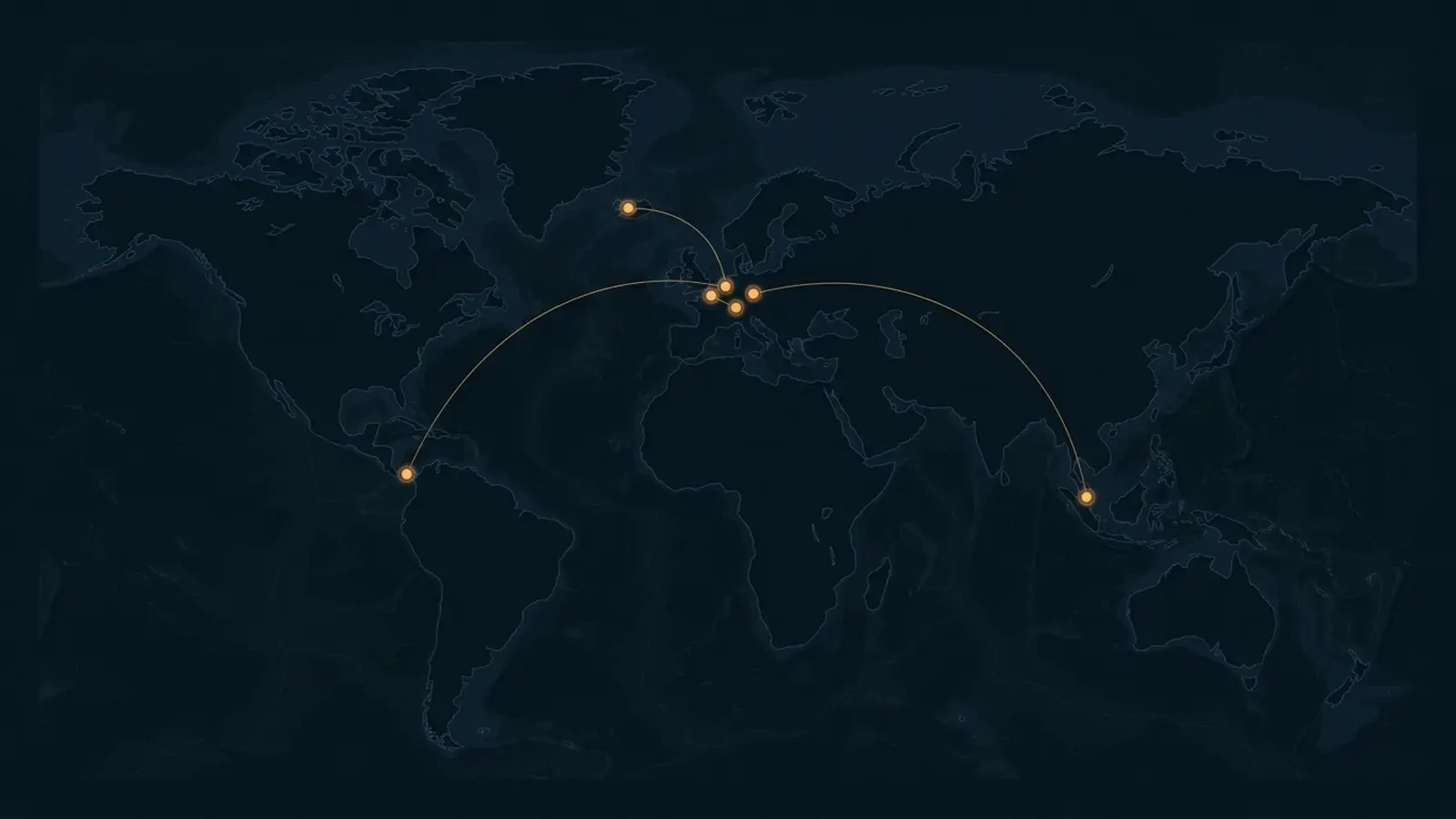 Offshore VPS
Offshore VPS hosting across 6 jurisdictions, Romania to Panama. Crypto-only, no identity checks, 1.5 Tbps mitigation, online in 15 min. From $8.00/mo.
Monero VPSMonero VPS hosting with XMR as a first-class payment, not a footnote. Top up a prepaid balance and deploy KVM servers in 6 offshore jurisdictions in 15 min.
 Bitcoin VPS
Buy a VPS with bitcoin: top up from $30.00, deploy in 15 min across 6 offshore regions. From $8.00/mo, 7 cryptocurrencies supported, no identity checks.
Register, top up from $30.00, deploy in 15 min. Nobody asks who you are.
Sign in to continue
Account created. These 8 recovery codes are shown once and never again. Each resets your password one time. Store them offline.