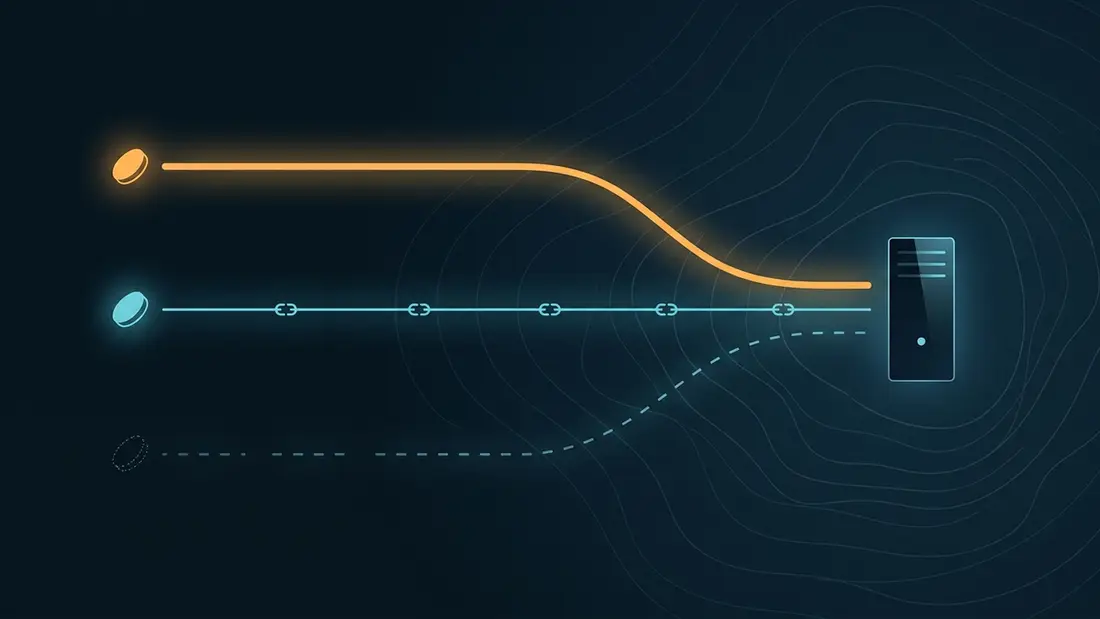
What no-KYC actually removes
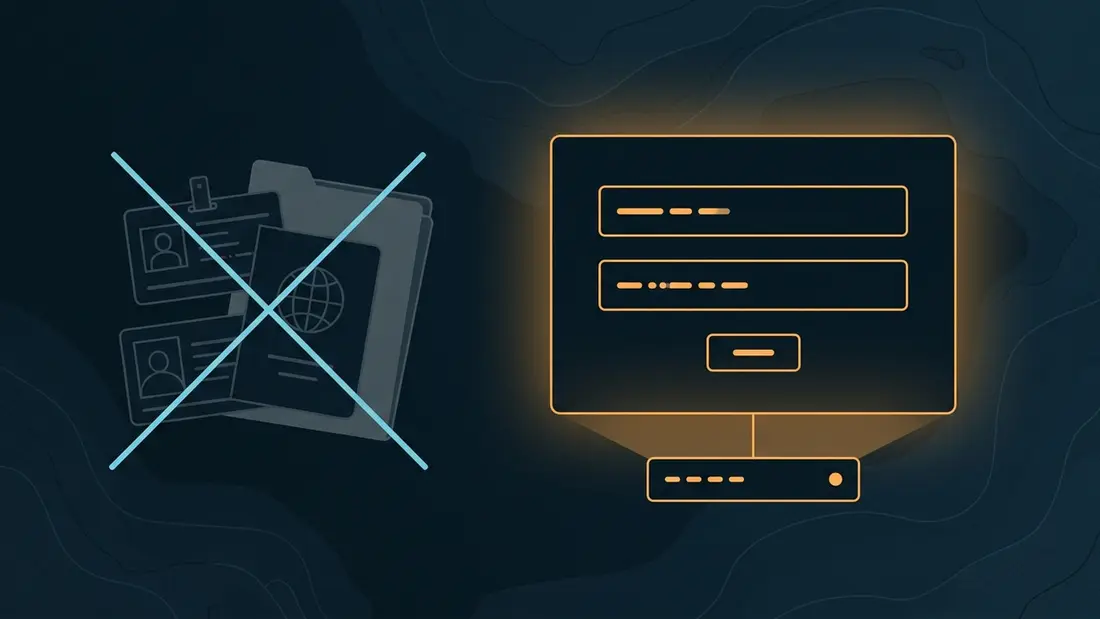
Conventional hosts collect a dossier before they sell you a server: legal name, billing address, phone, a card (which carries its own KYC), and often a "fraud check" that quietly means an ID upload. Every item exists for their payment rails and their compliance posture, not for running your workload — a hypervisor does not need to know your name to boot a VM.
No-KYC hosting removes the dossier and keeps the hypervisor. At signup here the entire form is a handle — any pseudonym — and a password. No email, no phone, no name, no address, no card, no "verification level" to unlock later. Payment is crypto-only into a prepaid balance, so no card processor or billing profile ever enters the relationship.
Be careful with the label elsewhere: plenty of providers advertise "anonymous VPS" but require a working email, log it forever, and reserve the right to demand documents "in case of suspicion". The test is what the signup form and the privacy policy actually say, not the marketing page.
SP·02The signup flow, concretely
Here is the entire flow, with nothing omitted. You pick a handle — 3 to 63 characters, letters, digits, dots, dashes, underscores; a throwaway pseudonym is fine and most users choose one. You set a password of at least 12 characters, which is stored as an argon2id hash. You tick one checkbox accepting the acceptable-use policy. That is account creation, complete, in under a minute.
Immediately after, the account issues eight one-time recovery codes in the form XXXX-XXXX-XXXX and shows them exactly once, with a download button. These are your password reset mechanism — more on that below. Optionally, you enable TOTP two-factor from the account page: standard RFC 6238 codes that work with any authenticator app, no phone number involved.
From there the path to a server is: top up the balance with crypto (between $30.00 and $5,000.00 per top-up), pick a plan and one of the 6 regions, and deploy — online in about 15 min for a VPS, 2–12 h for dedicated hardware. At no point does a verification step appear, because none exists in the codebase.
SP·03Recovery codes instead of email resets
The email reset link is the internet's default account recovery — and its default identity leak. An email on file ties the account to a mailbox, the mailbox to an IP history, and usually to a phone number via the mail provider's own recovery chain. A host that keeps no email cannot send reset links, so something must replace them.
Recovery codes are that replacement. Each of the eight codes is a one-time credential: burning one, together with your handle, lets you set a new password. They are stored server-side only as SHA-256 hashes, so a copy of our storage does not reveal them. Used codes are dead; you can regenerate a fresh set from the account page at any time (which invalidates the old set), and you should after consuming a few.
Treat the codes like cash. Sensible storage: a password manager entry, an encrypted file, or paper somewhere safe — ideally two of those. The failure mode to respect is total: lose the password and all eight codes and the account is unrecoverable by design. There is no support channel that can override it, because an override path for you is an override path for an impersonator, and we have no identity on file to tell you apart with. That hard edge is the price of the property you came for.
SP·04What a no-KYC host still holds
No-KYC is not no-data, and a provider that claims to hold nothing at all is lying or broken. The honest inventory here, mirrored on the no-KYC policy page: your handle, the argon2id password hash, hashed recovery codes, the balance and its transaction ledger, the specifications of what you ordered (plan, region, OS, term), and webserver access logs rotated at 14 days. Orders also record the IP that created them — which is why the consistent advice is to use Tor or a VPN from first contact, so that even the short-lived operational data is clean.
What does not exist anywhere in the system: a name, an address, a phone number, an email, a card, a payment processor profile, or analytics trackers stitching sessions together. The difference between "holds little" and "holds nothing" matters when you model the worst case: a full copy of our storage describes servers and balances, not people.
SP·05Tradeoffs you accept
No-KYC hosting drops features alongside the dossier. Worth accepting consciously:
- No recovery of last resort. Password and codes gone means the account and its balance are gone. Nobody can verify you back in, because nobody knows who you are.
- No chargebacks. Crypto is final. The counterweight is the refund policy: unused balance is refundable in crypto within 30 days of the top-up that funded it, minus network fees.
- Crypto-only. No card, no PayPal, no wire. If that is a blocker, this model is not for you.
- Rules still apply. No-KYC is not no-rules: spam, CSAM, malware C2 and attack launching get servers removed under the AUP, identity or not.
On takedowns, our posture is jurisdictional, not rhetorical: DMCA notices are not processed or answered — the DMCA is a US statute with no force in the jurisdictions our hardware sits in. We act on binding orders from a court with jurisdiction over the specific server, and on nothing less. What that means per region is on the locations page.
SP·06Day-two operations without an email
The part nobody warns you about is everything email quietly did after signup. There are no renewal reminder messages, no "new login detected" alerts, no newsletter — and no way to send them, because there is no address to send to. The panel replaces the mailbox: the servers view shows every box with its term and renewal date, the ledger itemizes every balance movement, and the order pages carry provisioning status. Make a habit of a thirty-second panel check around renewal time; that is the entire maintenance burden of the model.
Support works the same way. Tickets open from the panel and are answered there — no ticket-by-email thread tying your infrastructure to a mailbox provider's logs. For anything sensitive, that is strictly better: the conversation lives inside the same pseudonymous account as the servers it concerns.
The discipline that matters most is credential custody, because routine fades. Recovery codes belong offline from day one, TOTP should be enabled while the account is fresh, and if you regenerate codes after using a few, the old set dies — update your stored copy immediately, not "later". Day-two failures in no-KYC hosting are almost never the host; they are users discovering their only credentials lived in a browser tab.
SP·07How to vet any no-KYC provider
The label is cheap; verify it. A vetting list that takes ten minutes:
- The signup form itself. If it asks for an email, it is keeping one. "Optional" fields count.
- Payment rails. Card support means a processor with KYC sits in the chain. Crypto-only, ideally with Monero first-class, is the consistent posture.
- A written data inventory. Look for a specific list of what is held and for how long, with log-retention numbers. Vague "we respect privacy" prose is a red flag.
- Recovery design. If there is no email, what replaces resets? A provider that has not thought about this will improvise badly when you are locked out.
- Abuse posture in writing. Honest providers say what gets you removed and what legal process they answer to. "Ignore everything" is a promise nobody can keep; due-process-only is one they can.
- Refund terms. Prepaid models need an exit; ours is stated above and in the FAQ.
Any provider that fails two or more of these is selling the word, not the property.