The privacy ladder
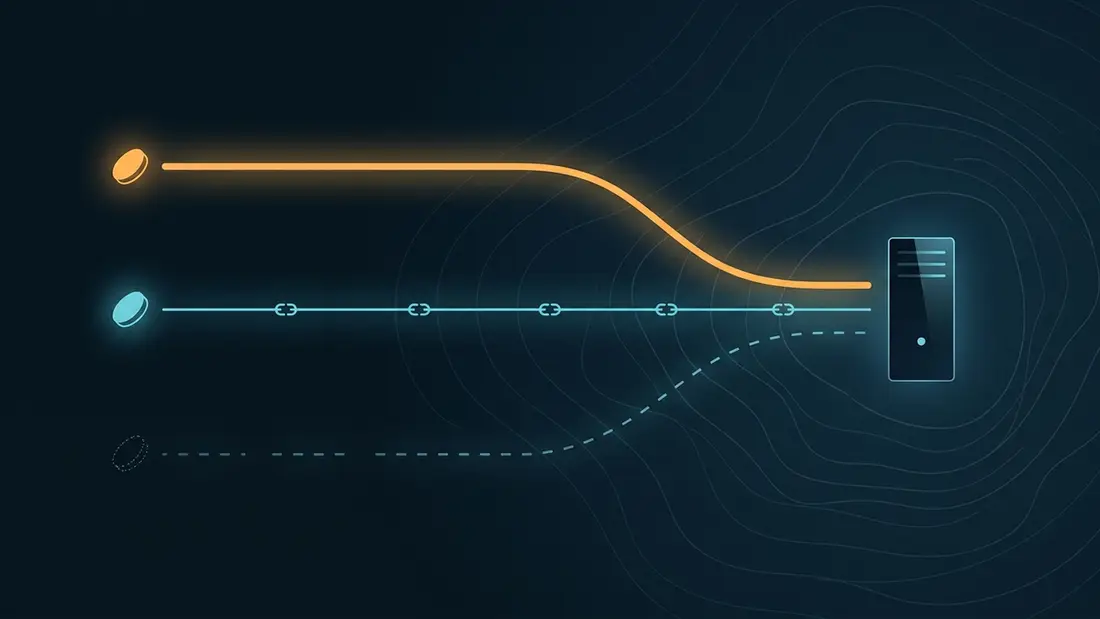
Rank the rails by what an outside observer can reconstruct, and the order is stable: Monero at the top, Bitcoin in the middle with caveats, stablecoins and other transparent chains at the bottom. Two axes decide it. First, what the chain itself reveals — amounts, counterparties, and whether payments can be linked into a history. Second, what your acquisition path reveals — a coin bought with full KYC carries that tag to the first place you spend it on a transparent chain.
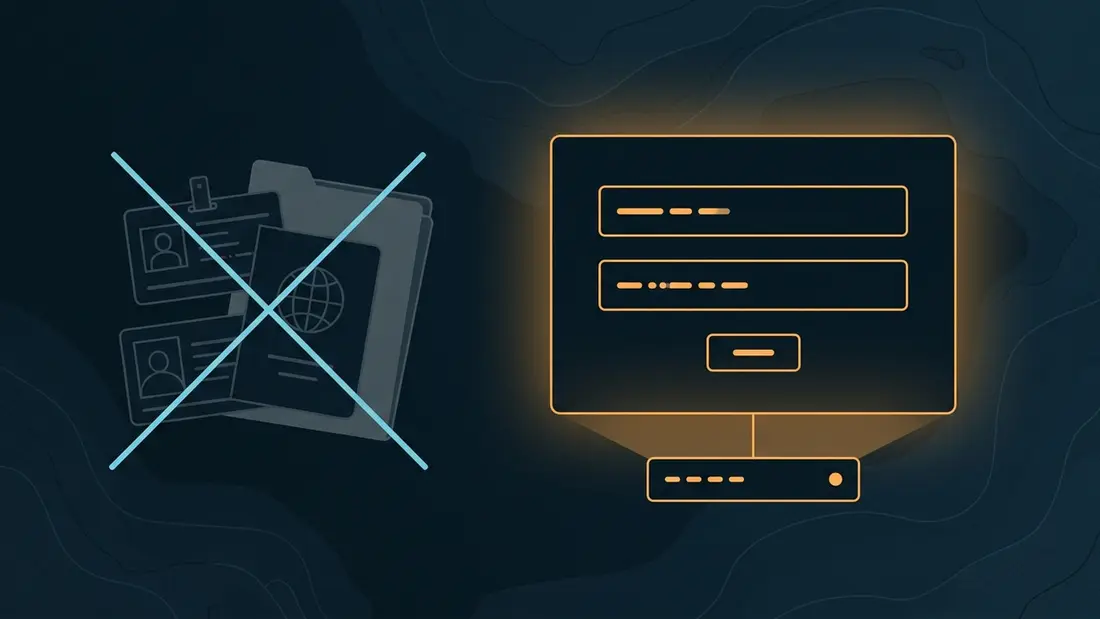
Neither axis matters if the host itself demands a passport. An anonymous payment to a provider that photographs your ID is theater; the payment rail and the signup policy have to match. That is the pairing this site is built around: crypto-only checkout on one side, a handle-and-password account on the other, with servers from $8.00/mo paid from a prepaid balance rather than per-invoice — a model that itself reduces how often you touch a chain at all (why that matters).
SP·02Monero: private by default
Monero hides the three things that make chain analysis work. Ring signatures mix every spend among decoys, so no observer can say which output was consumed. Stealth addresses generate a unique on-chain destination per payment, so the recipient's address never appears publicly. RingCT commits to amounts without revealing them. There is no transparent mode to fall back to and no "rich list" to appear on — privacy is the protocol, not a feature flag.
What remains is honest to spell out. The merchant knows its own invoice was paid — by design, and harmless. Timing correlation survives: if you broadcast from a home IP without Tor, your ISP can place a Monero transaction at your address at that moment, even if it cannot read it. And the acquisition trail survives: a KYC exchange knows you withdrew XMR and how much, it just cannot follow it onward. For paying a host, that combination — spend privacy intact, acquisition known at worst — is as good as the current landscape gets, which is why our Monero walkthrough treats it as the default rail.
SP·03Bitcoin: pseudonymous, not anonymous
Bitcoin's ledger is a permanent public record, and "pseudonymous" decays fast under analysis. The common-input-ownership heuristic clusters addresses into wallets; exchange KYC data tags clusters with names; and once one address in your cluster is tagged, the history of all of them is readable — retroactively, forever, with tooling that only improves.
Hosting makes this worse than a one-off purchase. Pay a provider monthly from the same wallet and you have built a clean recurring edge in the graph: same merchant, regular cadence, similar amounts. Anyone who ties one payment to you ties the whole series, and every server it funded.
Mitigations exist but are partial. Fresh receive addresses protect incoming payments, not your spends. Coin control keeps tagged UTXOs away from sensitive payments if you are disciplined. The honest fix is simpler: swap BTC for XMR at a no-KYC swap service before paying — one extra hop that converts a permanent public record into a private one. We accept BTC directly and it works fine; the checkout is not the problem, the chain is.
SP·04Stablecoins and the rest
Stablecoins are the weakest rung for privacy, for two stacked reasons. They live on transparent chains — every USDT transfer on Ethereum or Tron is public, and account-model chains are worse than Bitcoin's UTXO model here, since one address tends to accumulate your entire history. And they add a central issuer that can freeze funds and blacklist addresses, a power exercised routinely. Surveillance tooling on Tron in particular is dense, precisely because fees are low and volume is high.
The other transparent coins — Ethereum, Litecoin, TRON and Solana — fare no better: Litecoin shares Bitcoin's ledger model with somewhat thinner analyst coverage, and Ethereum and TRON are the account-model chains the stablecoins ride on. Less tooling is not privacy; it is obscurity with an expiry date.
We still accept all of it — 8 coins and network variants across 7 currencies — because convenience is a legitimate reason to choose a rail, and a prepaid balance means even a transparent top-up happens once, not monthly. Just place each rail honestly on the ladder, and reach for XMR when the payment is the part you most need private.
SP·05Metadata beyond the chain
The chain is only one layer. The rest of the trail:
- Broadcast IP. Your wallet talks to a node; the node sees your address. Run your own or connect through Tor.
- Light-wallet servers. SPV and Electrum-style wallets ask a server about your addresses specifically — that server learns your wallet's contents even when the chain hides nothing else.
- The browser session. The machine that opens the invoice exposes IP and fingerprint. Tor Browser, or at minimum a VPN you trust, for checkout and panel alike.
- Account identifiers. An email address at signup undoes everything upstream of it. Here the account is a handle and a password — there is no email field to leak.
- Host-side logs. Ask any provider what they retain and for how long. Our inventory is on the no-KYC page: order specs, balance ledger, and access logs rotated at 14 days. No card processor or fiat gateway ever enters the picture.
Matching the rail to your threat model
Not every payment needs the full ceremony, and pretending otherwise is how people burn out and get sloppy where it counts. Three rough tiers cover most real situations.
Casual privacy — you simply do not want your hosting spend in a marketing dataset or visible to anyone who learns one of your addresses. Any accepted coin into a prepaid balance already beats a card on file by a wide margin; pay from your own wallet and move on.
Serious pseudonymity — the server should not be attributable to you by a motivated civil party or data-broker-grade analysis. Here the transparent chains start to fail you: use XMR for the top-up, Tor or a trusted VPN for every session, and a handle that appears nowhere else on the internet.
Adversarial conditions — assume subpoenas to exchanges and professional chain analysis. Now acquisition matters as much as the spend: coins should be acquired without KYC in the first place, broadcast only over Tor from your own node, and the operational rules below stop being suggestions. The marginal cost of each tier is real; pick the one your situation actually requires and execute it consistently rather than aspirationally.
SP·07The opsec checklist
Condensed into one list — each line is cheap on its own, and together they close the trail end to end:
- Acquire coins without KYC where lawfully possible; if you must KYC, withdraw to your own wallet immediately.
- Swap transparent coins to XMR before sensitive payments.
- Run your own node, or reach remote nodes only through Tor.
- Use Tor Browser or a trusted VPN for the invoice and the panel — consistently, not just at signup.
- Pick a pseudonymous handle unique to this provider; never reuse nicknames across services.
- Unique 12+ character password from a manager, TOTP enabled, recovery codes stored offline.
- Fund a prepaid balance once rather than paying per-invoice every month.
- Pay from your own wallet, never directly from an exchange account.
None of this requires exotic tooling — a wallet, Tor, and ten minutes of discipline. The expensive part is consistency, and that's a habit, not a purchase. Where to spend the balance afterwards: VPS or dedicated, in 6 jurisdictions.